Welcome to the Zasadzinski Research Group!

The Zasadzinski Lab
Prof. Zasadzinski’s group's research deals primarily with understanding the fundamentals of colloidal systems through experimentation, rheological analysis, and imaging. The Z group, inspired by Joe’s push to “see the science”, has developed many novel imaging techniques over the years including a custom-built capillary pressure microtensiometer, a portable capillary pressure microtensiometer, and a modified Langmuir trough and confocal fluorescence microscope set up. In addition to these, our group uses many other imaging techniques, making it one of the few in the world to utilize all major microscopy techniques.
Currently, the group has two main directions:
1). Understanding lung surfactant monolayer behavior to ultimately suggest solutions lung surfactant diseases. For this project, we use a combination of our custom interfacial rheometers to measure the shear and dilatational moduli of various surfactant as well as fluorescent and confocal fluorescent microscopy techniques to study the effects of certain surfactant species and better understand the interplay of the surfactant molecules. Additional analyses can be performed using the curved interface of our custom capillary pressure microtensiometer and physical properties can be deduced via atomic force microscopy (AFM). We are motivated by the effects this research can have on improving the lives of premature babies, 50% of whom need replacement lung surfactant if born earlier than 28 weeks (Avery, 2000). Additionally, we are motivated to develop better treatment for adults with lung surfactant issues, like acute respiratory distress syndrome (ARDS), which has no known cure and was present in upwards of 90% of all COVID-19 ICU patients who passed away (Tzotzos et al., 2020). This project is funded by the NIH Heart Lung and Blood Institute and the Interfacial Science Division of NSF.
2). Develop safer fire-fighting foams free of PFAS chemicals. PFAS are per- and polyfluoroalkyl substances that were historically used as fire-fighting foams. These chemicals, known as “forever chemicals” are very difficult to break down and can have several health risks. We utilize our group’s history of surfactant work to study and eventually suggest alternative fire-fighting foams made of safer and sustainable surfactant molecules. We use combinations of industrial and other surfactants to deduce the fire-fighting potential of these combinations. Additionally, we suggest new thermodynamic models to improve our understanding of these soluble surfactant solutions. This project is funded by the Strategic Environmental Research and Development Program, or SERDP.
We invite you to reach out and get to know us more!

Around the table from left to right: Josie Kelpsas (UG), Joe Zasadzinski (PI), Boxun Huang (UG), Anisha Veeren (PD), Melody Ko (GS), Meenal Rathi (GS), Ziwen He (PD), Liam Wright (UG), and Zach McAllister (GS).
Please click the headers above for more information about me or contact me.
What's New?

August 2026
Zachary McAllister successfully defended his PhD Thesis "Monolayer Physics and Replacement Lung Surfactant Therapy Characterization". He is moving forward as a Postdoctoral Associate at the Naval Research Lab continuing his focus on surfactant research, this time with an application for PFAS replacement. Congratulations, Doctor!

June 2026
Many of our group members including Ziwen He, Melody Ko, Meenal Rathi, Pragnya Chatterjee, Musarrat Makhnun, and Zach McAllister were able to attend this year's ACS Colloids presentation and share their research. Zach was also a finalist in this year's Langmuir Graduate Student Award and won a poster award. Way to go!

November 2025
Zach McAllister won the Interfacial Science Poster Contest and was awarded the Pharmaceutical Discovery, Development and Manufacturing student award while at the AIChE meeting! Way to go, Zach!!

November 2025
Meenal, Ziwen, and Zach were all able to attend this year's AIChE conference and present their research!

While at the conference, we were able to connect to several previous members of the lab including Prajna Dhar, Olu Ogunyankin, Younjin Min, and Boxun Huang (below).

October 2025
Ziwen He was awarded Honorable Mention in this year's Nikon Small World in Motion. Congratulations, Ziwen! See more here.
September 2025
Meenal Rathi was awarded the 2025 ACS Langmuir Graduate Student Award for her presentation on novel fire fighting foam formulations at this year's International ACS Colloids Meeting! Way to go Meenal!!
September 2025
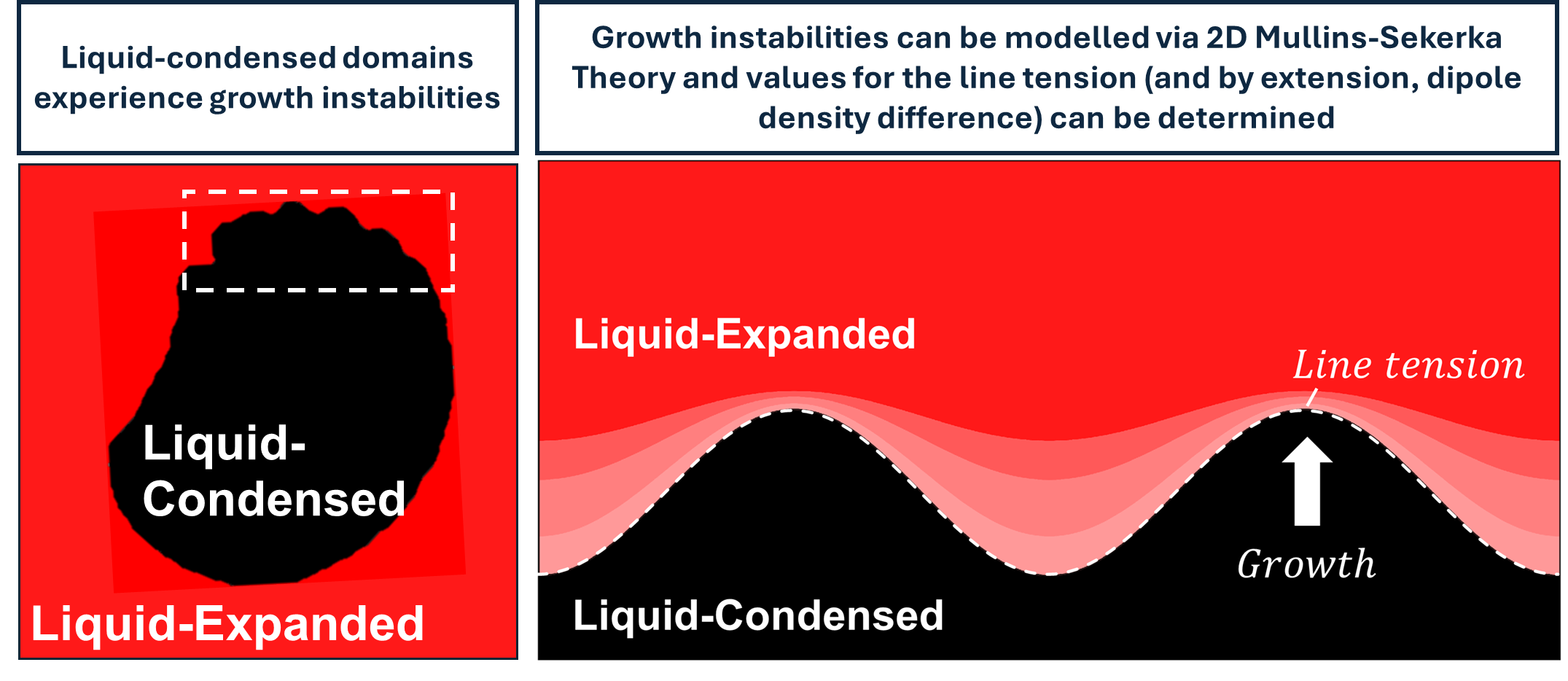
Zachary McAllister had his recent work about measuring the line tension in liquid-condensed-liquid-expanded (LC-LE) monolayers published in the Journal of Colloid and Interface Science. His work also has broader applications to understanding and interpreting LC-LE monolayer morphology. Awesome, Zach! Read more here.
June 2025
Joe Z. was recently invited to give the "Langmuir lecture" at the America Chemical Society National Meeting this Fall in Washington DC. The award bears the name of Irving Langmuir who was awarded the 1932 Nobel Prize in Chemistry for his work in surface chemistry. This prestigious invitation includes free travel and a financial award. Way to go Joe!
April 2025
Meenal Rathi was awarded the 2025-2026 Doctoral Dissertation Fellowship due to her high-impact research on PFAS-free fire fighting foams. Go Meenal!
Feb 2025
Meenal Rathi recently had her paper accepted to the Journal of Colloid and Interface Science! The paper highlights surfactant transport of commercially available surfactant solutions to replace traditional PFAS-based fire fighting foams. Way to go, Meenal! Check the paper out here.

Feb 2025
Zach McAllister recently won the Minnesota Crucible Prize entrepreneurial competition for his idea and analysis of a potential future synthetic replacement surfactant company. Read more here.

Oct 2024:
Zach McAllister had a chance to present at this year's AIChE Conference in San Diego. He spoke on a new, non-perturbing way to measure line tension in lipid monolayers.

Oct 2024:
Zach McAllister recently won the National Nanotechnology Coordinated Infrastructure (NNCI) Most Stunning Award for their 2024 "Plenty of Beauty at the Bottom" Competition. His submission called "Swirling Surfactant Sea" won by popular vote and includes a $1000 travel grant. Zach was also interviewed by the College of Science and Engineering for this award which can be found here.

Aug 2024:
Boxun Huang recently just got published in the Journal of Colloid and Interface Science. Check it out here.

April 2024:
One of our undergraduate researchers, Boxun Huang, recently accepted his offer to attend graduate school at MIT. We'll miss you Boxun!

April 2024:
Joe recently took part in an interview with Healio where he discussed Acute Respiratory Distress Syndrome (ARDS) and what is being done to treat this disease that affected ~150,000 Americans each year with a 40% mortality rate and currently no known cure. Here's a link to the interview (3 minute read) link.
February 2024:
Clara Ciutara's recent PNAS paper received a recent commentary paper by Charles Maldarelli, an expert on adsorption and fluid mechanics from the City College of New York where he applauded and summarized the research done as well as provided a critical analysis on how to move forward from this research. You can read it here: link. Here is a figure from the paper:

Decemeber 2023:
Clara Ciutara's recent PNAS paper will also feature one of her images of lysoslipid and DPPC as the cover art! We think it looks like a duck... You can decide for yourself!

December 2023:
We are happy to announce that all three of our undergraduate students, Anjiya Panjwani, Josie Kelpsas, and Liam Wright were awarded funding for their research through this year's Undergraduate Research Opportunities Program (UROP). The award includes $1800 per researcher as well as $300 per researcher to use in purchasing lab materials. Our undergrads rock!
November 2023:
Boxun Huang, an undergraduate student, Zach McAllister, PhD Candidate, and Dr. Zasadzinski presented at this year's AIChE conference in Orlando. Way to go!

November 2023:
The Zasadzinski group extends a warm invitation to three new graduate students, Musarrat Makhnun, Pragnya Chatterjee, and Melody Oi Lam Ko, and one new post-doctoral student, Ziwen He. Musarrat and Pragnya will be working on the foams and ferfluorinated surfactant project, and Melody will be working on the lung surfactant project. Ziwen He will join us officially in January.
October 2023:
The Zasadzinski group, in connection with the Dutcher group, receive funding from the Strategic Environmental Research and Development Program (SERDP) to study PFAS-free fire-fighting foams. Meenal Rathi, PhD Candidate, is excited to be one of the head leaders on this project.
October 2023:
The Zasadzinski group is happy to announce a collaboration with Moderna to determine the relevant colloidal properties in mRNA-LNP drug product suspension. The project will be headed by Dr. Anisha Veerren, a post-doctoral associate in the Zasadzinski group.
October 2023:
We are happy to announce that Zach McAllister recently received "Honorable Mention" for the "Most Stunning" category of this year's National Nanotechnology Coordinate Infrastructure (NNCI) "Plenty of Beauty at the Bottom" imaging contest. More information can be found here: https://nnci.net/plenty-beauty-bottom

July 2023:
Zachary McAllister receives the NIH Ruth L. Kirschtein Predoctoral Individual National Research Service Fellowship Award for his research, "Three-dimensional Confocal Microscopy Visualization and AFM-IR Chemical Mapping of Lung Surfactant Monolayer Collapse Morphologies." The award is designated for three years and includes a stipend.
In addition, Zachary McAllister also receives the Arvind Varma travel award to attend the conference of his choice. He plans on attending this year's AIChE conference in Orlando.
June 2023:
The group says goodbye to Dr. Steve Iasella who after completing his post-doctoral research has begun work at DOW Chemical. We will miss you Steve!
April 2023:
Joe Z accomplishes his 20,000th literature citation. We, naturally, celebrated with cupcakes. Congrats, Joe!!

February 2023:
Joe Z is elected as a Fellow of the American Institute of Chemical Engineering (AIChE), the highest grade of membership. The grade of Fellow is awarded to members in recognition of significant professional accomplishments and contributions in engineering. Way to go, Joe!
January 2023:
The group says goodbye to two great graduate students, now Dr. Cain Valtierrez-Gaytan and Clara Ciutara. We wish them the best of luck at DOW Chemical and Henkel!
September 2022:
Check out our recent JCIS, JoVE, and AIP publications! We established colloidal/interfacial science background as well as interfacial rheology tool development and validation for surfactant study.
June 2022:
Steve and Clara present at U.S. National Congress for Theoretical and Applied Mechanics. Clara won a prestigious Thomas Hughes fellowship to cover her travel expense.
May 2022:
The group bids farewell to Sourav Barman who will be starting in Intel soon. Best wishes!
January 2022:
The Z group welcomed two fantastic new graduate students, Meenal Rathi and Zachary McAllister. Zachary will be working on the lung surfactant projects and Meenal is co-advised with Cari Dutcher and will be working on foam stability. Sourav Barman will be leaving the group in the summer to go to Intel in Oregon after becoming the world’s expert on dilatational rheology of lung surfactant interfaces. His two papers in Soft Matter show how dilatational rheology influences lung stability and how Covid-19 induced inflammation can destabilize the lung and prevent normal breathing. Steve Iasella received an NIH Postdoctoral fellowship and has built a new dilatational rheometer that allows high speed confocal imaging of the interface. Steve’s device can also do sophistical model-based control so that we can examine interfaces at constant area while the surface tension is changing for the first time. Steve has shown that lysolipids are capable of “washing” lung surfactant films from the interface, thereby changing the dilatational properties leading to lung instabilities. Clara Ciutara published her first paper in Soft Matter describing the bulk rheology of lung surfactant suspensions to show that the aggregate microstructure has a profound effect on the yield stress and shear thinning properties of the suspensions. Her work also highlights the profound rheological differences between lung surfactants and proteins (such as albumin) at the air-water interface.

Cain Valtierrez-Gaytan has done some incredible imaging with the confocal microscope to see the first ever equilibrium morphology transition in lung surfactant mixtures as shown in the picture above. Cain has seen a number of monolayer textures for the first time and his work is in press in Science Advances. Joe Barakat, another NIH post-doctoral fellowship recipient who is co-advised with Todd Squires at UC Santa Barbara was the theory expert on Cain’s paper. Ben Stottrup, adjunct professor at the U of M and professor of physics at Augsburg University, rounded out the team. Anisha Veeren has been able to deliver mRNA to model T-cells using pulsed laser light triggering of plasmonic gold nanoshells tethered to liposomes containing the mRNA. She’s seen highly efficient transfection indicated by the green fluorescent protein with minimal cell toxicity. Her first paper is in press at Pharmaceutics. Finally, the great work of all led to another $2,000,000 renewal of our NIH grant, Lipid and Protein Effects on Monolayer Stability, which has been going for 30 years.